
Sandmark Technologies — Projects
A wide field of work I'm proud of—scan the breadth, then click any tile for the story of what we built and why it mattered.
Artificial Intelligence
Neural networks, local models, agents, and real-world applications.
During my career, AI has gone from science fiction, to a deep research field splitered into many competing factions across academic departments, to fledgling novelty, to awkward tool, to dependable assistant. The part of studying AI that interested me was reinforcement learning. Projects I worked on included a chess playing agent that competed against other student work and I won 3rd place. I also enjoyed working on agents that would learn to avoid collisions while navigating and searching.
Autonomic Sensor Networks
Swarm behaviors, coverage algorithms, and fault tolerance.
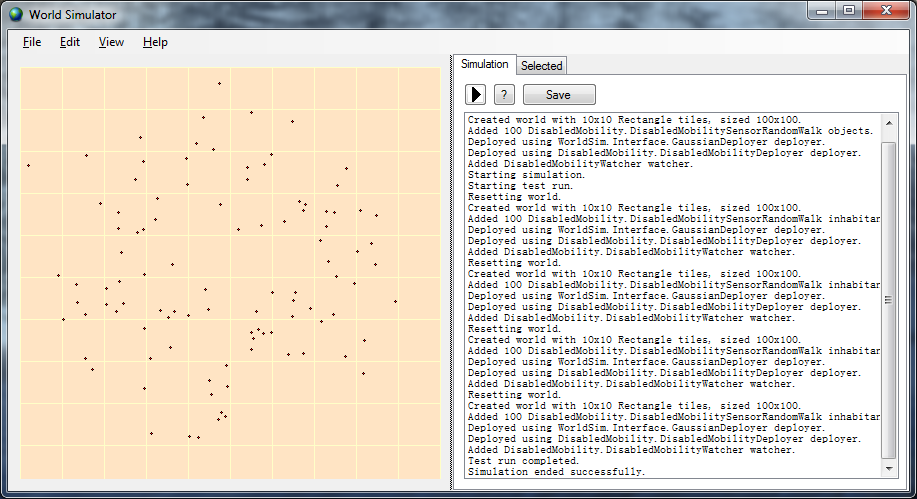
My thesis and dissertation work lived inside a purpose-built C# simulation platform. Reflection and modular design let us swap algorithms for swarm coverage and fault tolerance without rewriting the world—then compare results until the patterns were clear enough to publish and teach. That platform still stands as one of the coolest engineering artifacts I've owned: research-grade science wrapped in production-minded software craft. Lately, I have updated it from WinForms to WPF, continued to experiment with smarter agent implementations, and in addition to still using the original rectangular grid world, I have added a spherical world environment that still looks continuous to the agents, as well as a 3d world where I can experiment with asteroid fields, gravity, and inertial guidance with my agent implementations. SensorAnalysis on GitHub
CiteManager
A folder-backed citation library with a desktop UI and an agent-friendly CLI.
Research papers accumulate fast when exploring related work. Trying to remember which paper, where it came from, what it said, and how it relates to my work is a real bear when you get many papers written and dozens to hundreds of related works to wade through. CiteManager is an app I created that helps me manage this huge amount of information. Not only does it keep track of the above, it gives me one place to go to generate a bibtex entry for my paper's bibliography, and maintains a reading list of papers that I have looked up but haven't had a chance to dig through yet. It has been an amazing helper. This is the best kind of tool: automating something I was already doing manually, but fitting into my workflow seamlessly, not costing me anything, no fear about it being bloatware or nagware, and I can add features anytime I want to. It is a WPF app that treats a folder as the database: one directory per paper, JSON metadata, markdown notes, and a local PDF cache—git-friendly, no SQLite.
Agile & Lean Practices
Team efficiency, scrum, kanban, and iterative improvement that actually sticks.
After several successful commercial software cycles, I wrote Practically Agile (as yet unpublished) to unlock the sticking points managers and developers hit when they want the benefits of iteration without the theater. I'm proud of the teams that shipped predictably with less stress—and of capturing that playbook so others don't have to learn every hard lesson the expensive way.
Food Pantry Helper
Windows Universal app for pantry volunteers serving their community each week.
Published to the Windows Store to help volunteers manage paperwork for families receiving food and household goods. This one still means a lot: software that quietly strengthens community operations, built with the same care you'd give a commercial product, for people who show up every week to help neighbors. GitHub
MindMasterX
AI word-puzzle solver inspired by Fallout terminals; Xamarin to iOS, Android, WP8.
Fallout's terminal puzzles sparked a C# program that scores candidates, recommends the best next guess, folds in feedback, and iterates to the answer—then ports across mobile with Xamarin. Pure joy project energy, with a serious lesson underneath: clear problem decomposition travels well when you care about craft. GitHub
FishStorm
.NET survey platform with Couchbase, Docker, JWT auth, and analytics UI.
A full stack for collecting and analyzing surveys at scale: document storage in Couchbase, repeatable Docker deploys, JWT-secured access, and module UIs for authoring and dashboards. It's the kind of system I'm proud to point at—opinionated enough to ship, flexible enough for real teams to keep iterating. GitHub
WanderLit
MAUI Android concept for travel planning engagement with a beach-themed UI.
Built to show how engagement patterns and a pleasant UI can support travel planning and booking journeys. .NET MAUI on Android let us move fast while still caring about feel—the same instinct that shaped earlier travel platforms in my career, distilled into a focused mobile experience.
ElfPackageService
Java knapsack solver comparing brute force and dynamic programming.
A teaching- and analysis-oriented service that makes algorithmic tradeoffs visible: brute force versus DP, measured and explained. I love projects like this because they turn “hard CS” into something students and teammates can feel—performance as a design choice, not a mystery. GitHub
Achieving Nash Equilibrium in AI Development
Game theory on automation races, interventions, and sustainable equilibria.
Modeling AI capability races with replicator dynamics and related tools—asking when “everyone accelerates” is unstable, and which interventions nudge toward healthier equilibria. LaTeX drafts and Jupyter experiments keep the math honest. This is research I'm excited about because it connects incentives to outcomes people live with.
Trust between Heterogeneous Autonomous Agents
Trust envelopes and the cost of untrustworthy peers in multi-agent systems.
Quantifying how trust—and its loss—shapes performance in sparse networks of dissimilar agents. Drawing useful analogies from organizational trust models while staying grounded in simulation. Proud of the clarity this work brings: reliability is a system property, and you can show why with evidence.
Fault Tolerance with Limited Mobility
Resilience in sensor networks when nodes can't freely reposition.
Extending the sensor-network line to constrained mobility: adaptive algorithms and failure-mode analysis that keep coverage useful when relocation isn't an option. Simulation results fed both academic writing and classroom examples—proof that hard distributed problems reward patient, careful engineering.
Anomalous Web Traffic Detection
Formulations and approaches for spotting unusual request patterns.
Formulations and algorithmic approaches for detecting anomalous web traffic—pattern recognition and ML-oriented ideas aimed at security monitoring and performance diagnostics. Framed for clarity over hype: the kind of problem that rewards people who've lived through real production incident reviews.
DateTime Calculations in Windows
Time zones, DST, and the edge cases that break naive date math.
Practical patterns for reliable DateTime handling in Windows/.NET: time zones, daylight saving transitions, and the silent bugs that haunt scheduling and travel systems. I've shipped enough of those systems to know this unglamorous craft is where trust is won or lost.
Home Lab Adventures
Home Assistant, local AI agents, cameras, Docker, Hyper-V experimentation.
A living workshop: Home Assistant automations, camera integrations, containers, and local AI agents on Hyper-V Ubuntu and friends. Fluency comes from shipping small, reversible experiments—and that fluency shows up later when production decisions have to be made under pressure.
Hard Computer Science Problems
Knapsacks, optimizations, recursions, and algorithmic puzzles.
A continuing practice set in Java and C#: optimizations, recursive formulations, and puzzles that reward measurement. Complements classroom teaching and services like ElfPackageService—because staying sharp on fundamentals is how you earn the right to tackle novel systems later.
Herding Agents: Sheep and Sheepdog Models
Observable tells, inferential control, and goals like barrier coverage.
Two agent types: herd-like agents with observable signals, and shepherd-like agents that infer and act toward coverage or collision-avoidance goals. Explored in graduate coursework with reinforcement learning (including a kindergarten hallway collision scenario). The B grade taught as much as the A work—incentive design is hard— and I'm still excited about extracting governing dynamics worth publishing.
Sandmark Deals Engine
.NET travel deals service—Swagger API, Nginx proxy, environment-aware config.
Built around four P's—Popularity, Preference, Price, and Profit—so providers can surface deals customers recognize, matches to preferences, strong seasonal value, and healthy margins. A .NET service with a documented API and clean production/local configs. This sits in a long line of travel systems work I'm proud of: Expedia-era foundations, cruise and insurance platforms, and still caring about the customer's path to a great trip.